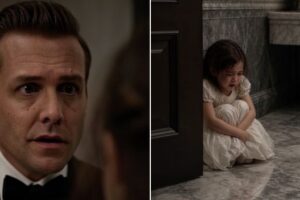
The sound of the slap echoed through the marble halls—and in the next heartbeat, my three-year-old daughter stood between me and the woman who thought she ruled us all.
“You can’t tell my mommy what to do.”
Emma’s tiny voice was soft, but it stopped an entire room.
She clutched her faded blue wool rabbit against her chest, her little cheeks glowing with determination, as though she had wandered into a war and decided the grown-ups had forgotten how to be kind.
She was only three.
She still called spaghetti pasghetti.
She still believed the moon followed our bus home every night.
And every evening, she kissed the cracked screen of my old phone because she was certain her daddy could feel her love through his photograph.
Now she stood barefoot in the service hallway of Villa Moretti, shielding me after the mafia boss’s glamorous fiancée had slapped me across the face.
The grand hall fell completely silent.
Not the silence that comes when people stop talking.
The kind that comes when everyone realizes something dangerous has just begun.
Crystal chandeliers glowed over polished marble floors while representatives of twelve of Italy’s most powerful families watched without moving. Men in tailored black suits froze with wineglasses in hand. Women draped in silk and diamonds stared across the room.
Even the jazz musicians stopped playing.
A splash of orange juice stained the Persian rug between us, and my cheek still burned from Vivian Romano’s hand.
Dressed in a stunning red Versace gown, her blonde hair sculpted into perfect waves, Vivian looked down at Emma with cold, practiced contempt.
“You should teach your child to know her place,” she said quietly.
Emma hugged her rabbit tighter.
“My mommy works harder than anyone here,” she whispered. “And you only know how to make people cry.”
A sharp breath escaped somewhere behind us.
My heart nearly stopped.
Vivian slowly raised her hand again.
Then a calm voice drifted down the corridor.
“Vivian.”
No one shouted.
No one needed to.
Every face turned toward the man standing at the end of the hallway.
Alessandro Moretti had arrived.
He wore a black dinner jacket without a tie, the open collar revealing the edge of a pale scar disappearing beneath his shirt. He was taller than I had expected, broader through the shoulders, his dark hair touched with silver near the temples.
But it was his face that unsettled me.
Not because it was cruel.
Because something about it hurt.
The shape of his eyes. The slight tilt of his head. The way his right hand curled as though the thumb had once been broken.
A strange pressure tightened around my ribs.
I had seen Alessandro only from a distance during the six months I had worked at the villa. Staff members were trained to become invisible whenever he entered a room. We lowered our eyes. We moved quietly. We never stared.
Now he was looking directly at Emma.
More precisely, he was staring at the faded blue rabbit in her arms.
His expression changed.
Only for a second.
But I saw it.
The ruthless composure slipped, revealing something raw and terrified beneath it.
He looked like a man who had just seen a ghost.
Vivian lowered her hand.
“Alessandro,” she said, recovering quickly. “The waitress spilled a drink on me. Then her child interrupted our guests.”
“She isn’t a waitress,” Emma said.
Vivian glanced at her.
Emma lifted her chin. “She’s my mommy.”
Alessandro’s eyes closed briefly.
When they opened, they were shining.
He crossed the corridor slowly.
Every step seemed deliberate, as though the floor might collapse beneath him if he moved too quickly. He stopped several feet from Emma and lowered himself to one knee.
Men who could command armies did not kneel.
Alessandro Moretti did.
“What is your rabbit’s name?” he asked.
Emma studied him suspiciously.
“Mister Moon.”
The color drained from his face.
Behind me, Vivian’s champagne glass slipped slightly in her fingers.
Alessandro noticed.
So did I.
“Who gave Mister Moon to you?” he asked.
“My daddy.”
His voice became almost inaudible.
“And where is your daddy?”
Emma looked down at the rabbit’s frayed ear.
“He went to heaven.”
Something shattered inside Alessandro’s expression.
He turned his gaze toward me.
“What was your husband’s name?”
The question sounded simple.
It felt like a blade.
“Daniel Vale.”
Alessandro stopped breathing.
Vivian stepped forward. “This is absurd. Security should remove them.”
“No one leaves the villa,” Alessandro said.
The calmness of his voice made the chandeliers seem to dim.
Vivian stared at him. “Excuse me?”
He rose to his full height.
“Close every gate. Lock the east entrance. Confiscate all phones belonging to Romano security.”
Across the hall, several men moved immediately.
Vivian’s father, Lorenzo Romano, emerged from the crowd. He was a silver-haired man with a polished smile and eyes that never smiled with him.
“This is an engagement celebration,” Lorenzo said. “Not a military operation.”
Alessandro did not look at him.
“Take Elena and the child to the west library.”
My skin went cold.
I had never told him my name.
“How do you know who I am?” I whispered.
His eyes met mine.
The familiarity struck again—so strongly that for one impossible moment, the marble hallway disappeared.
I remembered a tiny kitchen in Naples.
Rain tapping against the window.
Daniel standing barefoot beside the stove, ruining another pan of tomato sauce while humming the same four notes again and again.
I remembered laughing as he claimed burnt garlic was an ancient family recipe.
I remembered his hand resting over mine, his thumb marked by a thin white scar.
The same scar Alessandro Moretti had on his right hand.
Emma tugged my skirt.
“Mommy,” she whispered, “that man has Daddy’s eyes.”
The silence deepened.
Vivian’s face transformed.
Until that moment, she had looked irritated.
Now she looked afraid.
The west library smelled of leather, cedarwood, and old smoke.
Floor-to-ceiling shelves surrounded us. A fire burned beneath a carved stone mantel, though the spring night was warm.
Two guards stood outside the door.
Alessandro entered alone.
Emma sat beside me on a green velvet sofa, her rabbit tucked under her chin. I held her so tightly that she squirmed.
“Mommy, I need air.”
I loosened my arms, but not much.
Alessandro approached a cabinet and poured water into a crystal glass. His hand trembled badly enough that the rim tapped against the bottle.
That frightened me more than his guards.
Powerful men were not supposed to shake.
He placed the glass before me.
“I don’t want anything from you,” I said.
“I understand.”
“No, you don’t.”
His jaw tightened.
“My daughter and I are leaving.”
“It isn’t safe.”
“We were safe before your fiancée hit me.”
“No,” he said softly. “You only believed you were.”
I stood.
“What does that mean?”
Instead of answering, he crossed to an antique desk and opened the bottom drawer. From it, he removed a narrow wooden box.
He placed it on the table.
Inside lay a small green wool rabbit.
It was older than Emma’s, its fabric worn almost smooth. One button eye was missing. A crescent moon had been stitched onto its chest with silver thread.
Emma gasped.
“Mister Moon’s brother.”
Alessandro’s mouth tightened with grief.
“Our mother made two,” he said. “The green one for Alessandro. The blue one for Matteo.”
I looked at him.
“Who is Matteo?”
“My younger brother.”
“You don’t have a brother.”
“That is what the world was told.”
He opened a leather album. The first photograph showed two boys, perhaps eight or nine, standing in front of the villa fountain. They had identical dark hair and mischievous smiles.
Twins.
One held the green rabbit.
The other held the blue.
My knees nearly failed me.
The boy with the blue rabbit had Daniel’s smile.
“No,” I whispered.
“Matteo Moretti disappeared nine years ago,” Alessandro said. “He wanted nothing to do with this family. He left Italy under another name.”
I stared at the photograph.
The walls seemed to tilt.
“No.”
“He called himself Daniel Vale.”
“No.”
“He studied architecture in Florence. He hated olives but pretended to enjoy them because he thought refusing food was impolite. He played the piano when he was anxious. He could never sleep with a closet door open.”
“Stop.”
“He broke his right thumb when he was eleven after falling from the lemon tree behind the chapel.”
“Stop!”
Emma began to cry.
I dropped beside her instantly, pulling her into my arms.
“It’s all right, sweetheart.”
But it wasn’t.
Nothing was all right.
Daniel had told me he grew up in foster homes. He claimed he had no siblings. He said his parents died when he was young.
We had met in a bookshop during a thunderstorm. I had been reaching for the last copy of a travel guide when he grabbed it first, apologized six times, and bought me coffee to compensate.
He was gentle.
Awkward.
Kind.
He cried when Emma was born.
He danced with her in the hospital room and whispered, “The moon will always bring you home.”
Four months later, his rental car was found at the bottom of a ravine.
The police recovered his wedding ring.
They never recovered his body.
I had buried an empty coffin.
My grief had been an empty coffin too—beautifully polished, unbearably heavy, and filled with questions no one could answer.
I looked at Alessandro.
“Are you saying my husband was the brother of a mafia boss?”
“I am saying he was born into a family he spent his life trying to escape.”
“And you expect me to believe this because of a toy?”
“There is more.”
“There is always more with men like you.”
Pain flashed across his face.
Emma wiped her tears and looked at him.
“Did you know my daddy?”
His voice broke.
“Yes.”
“Did he love us?”
Alessandro turned away.
He braced both hands against the desk and bowed his head.
When he finally spoke, the words were ragged.
“More than anything in this world.”
Emma considered that.
Then she climbed down from the sofa and approached him.
I tried to stop her, but she slipped from my grasp.
She held out Mister Moon.
“You can hug him,” she said. “He helps when your heart hurts.”
Alessandro looked at the rabbit as though it were sacred.
He did not take it.
Instead, he touched the silver crescent sewn across its chest.
A click sounded.
The seam opened.
I stared.
Beneath the faded wool was a tiny silver key.
Alessandro pulled his hand back.
“What is that?” I asked.
“I don’t know.”
It was the first thing he had said that I believed completely.
The library door opened.
Vivian entered with Lorenzo and two men.
The guards outside did not follow them.
A chill slid down my spine.
Vivian had changed her expression. Her fear was gone, hidden beneath a graceful mask of concern.
“Alessandro, darling,” she said. “Your guests are becoming restless.”
His gaze dropped to the pistol carried by the man behind her.
“That weapon does not belong in my library.”
Lorenzo smiled.
“Tonight, many things will change ownership.”
Alessandro stepped between them and Emma.
Vivian noticed the silver key.
Her smile vanished.
“So Matteo kept it,” she whispered.
Alessandro’s face hardened.
“You knew.”
Vivian looked at me.
“I knew your little husband was sentimental.”
The room became unbearably still.
My voice came out thin.
“What did you do to him?”
She sighed, as though I had asked an exhausting question.
“Matteo created complications. He discovered financial records that did not concern him. He threatened to expose arrangements that had protected these families for generations.”
“You killed him.”
“I tried.”
The word struck harder than her hand had.
Tried.
Not succeeded.
I stared at her.
“What does that mean?”
Lorenzo’s pleasant mask cracked.
“Enough.”
But Vivian seemed to enjoy finally speaking the truth.
“The car went over the ravine. It burned. We searched for two days and found blood, but no body. A month later, someone accessed a dormant Moretti account using Matteo’s biometric signature.”
She looked toward Alessandro.
“Then Alessandro suffered an unfortunate explosion in Palermo. He disappeared for nearly a year and returned with a reconstructed face, a colder heart, and an obsessive interest in our finances.”
My mind resisted the implication.
I looked at Alessandro’s scars.
His broken thumb.
His familiar eyes.
The four-note melody he had been humming without realizing it.
Emma’s words returned to me.
That man has Daddy’s eyes.
“No,” I whispered.
Alessandro closed his eyes.
Vivian smiled.
“Tell her, Matteo.”
The world stopped.
Not figuratively.
Truly.
The fire ceased crackling. The air left my lungs. Even Emma seemed to freeze between us.
The man the world called Alessandro turned toward me.
When he opened his eyes, there was no mafia boss standing there.
There was a rain-soaked bookshop.
There was burnt garlic.
There was a hospital room and a newborn child.
There was my husband humming four notes beside a window.
“Elena,” he said.
Not in Alessandro’s controlled voice.
In Daniel’s.
In the voice I had begged the universe to let me hear one more time.
My knees buckled.
He moved instinctively to catch me.
I struck him.
The second slap of the night was quieter than the first.
But it carried three years of grief.
“You let me bury you.”
“Elena—”
“You let your daughter grow up kissing a photograph.”
“I thought you were dead.”
I hit his chest with both hands.
“You knew where we lived!”
“I went back. The apartment was burned. Romano police records listed you and Emma among the victims. I saw photographs. Dental reports. Death certificates.”
“They were forged,” Vivian said lightly. “Quite convincingly.”
Matteo turned on her with murder in his eyes.
Lorenzo’s men raised their guns.
Emma screamed.
The lights went out.
Gunfire exploded through the library.
Matteo threw himself over us.
Glass shattered.
Someone shouted near the door.
A hand seized my arm.
For one instant I thought it was Vivian.
Then I heard the voice of Rosa, the elderly housekeeper who had supervised the villa staff for thirty years.
“This way!”
She pulled aside a section of bookcase, revealing a narrow passage.
Matteo pushed Emma into my arms.
“Go!”
“What about you?”
“I’ll hold them here.”
“I already lost you once!”
His face changed.
Even in darkness, I saw it.
Hope.
Pain.
Love.
All the emotions he had buried beneath Alessandro Moretti’s name.
“You never lost me,” he said. “They stole the road between us.”
Another shot struck the desk.
“Go!”
I carried Emma into the passage.
Rosa followed and dragged the bookcase shut behind us.
The tunnel was narrow and freezing.
Emma buried her face against my neck as we moved through the darkness. Behind us, gunfire echoed through the walls.
“Where does this lead?” I asked.
“The old chapel,” Rosa said.
“Why?”
“Because Matteo put something there before the accident.”
“You knew who he was?”
“I changed his diapers.”
The answer was so unexpected that I nearly stumbled.
Rosa struck a match, illuminating her lined face.
“The twins were inseparable. Alessandro was bold. Matteo was gentle. One wanted to inherit the world. The other wanted to redesign it.”
“What happened to Alessandro?”
“The Palermo explosion.”
“But Vivian said—”
“She said Matteo returned with a reconstructed face.”
Rosa’s eyes met mine.
“She did not say whose face the surgeons reconstructed.”
I stared at her.
Rosa continued.
“When Matteo survived the ravine, he contacted his brother. Together they began gathering evidence against the Romanos. Vivian discovered their plan and ordered the Palermo bombing. Alessandro died that night.”
The words settled like dust over a grave.
“Matteo took his brother’s identity.”
“To prevent Lorenzo from seizing the Moretti organization. To finish what they started. And because after your supposed deaths, he had nothing left except revenge.”
A sob escaped me before I could stop it.
Emma lifted her head.
“Mommy, look.”
The silver crescent on Mister Moon’s chest glimmered in the matchlight.
It was not decorative.
It pointed toward a small opening in the stone wall.
“Rabbits know the way home,” Emma said.
My heart stumbled.
Daniel used to say that whenever Emma crawled beneath the furniture.
Rabbits always know the way home.
I inserted the silver key into the opening.
A section of stone shifted.
Beyond it lay a circular chamber filled with old electrical equipment, filing cabinets, and a single grand piano coated in dust.
On top of the piano rested a green rabbit.
Alessandro’s rabbit.
Beside it sat a metal case.
Rosa opened it.
Inside were ledgers, photographs, audio recordings, passports, and a small black transmitter.
“The Romano archive,” she breathed. “Payments, judges, ports, shell companies. Everything.”
A red light blinked on the transmitter.
Rosa smiled.
“Matteo was clever.”
“What does it do?”
“It has been transmitting since you turned the key.”
“To whom?”
A deep bell sounded from the chapel above us.
Once.
Twice.
Then the distant roar of helicopter blades shook dust from the ceiling.
Rosa’s smile widened.
“To everyone.”
We returned through the chapel stairs.
The grand hall had become a battlefield frozen between violence and surrender.
Lorenzo’s men held several guests at gunpoint. Vivian stood on the central staircase with blood staining the sleeve of her red gown.
Matteo knelt near the fountain, one hand pressed against a wound in his side.
Lorenzo held a pistol to his head.
The doors burst open.
Armed officers flooded the villa from every entrance. Red lights flashed through the windows as helicopters descended on the lawn.
Lorenzo shouted, “Put down your weapons!”
No one obeyed him.
A woman in an evening gown stepped away from the group of terrified guests. She removed a diamond pin from her hair and dropped it to the floor.
A microphone was hidden beneath it.
“Lorenzo Romano,” she said, “every word spoken in this villa tonight has been transmitted to the National Anti-Mafia Directorate.”
Vivian stared at her.
“You.”
The woman smiled.
“The jazz band was excellent cover.”
Across the hall, the pianist lifted his hands from the keys.
The musicians had never stopped because they were frightened.
They had stopped because they were listening.
Lorenzo tightened his grip on the pistol.
“I will kill him.”
I stepped into the hall.
His gaze snapped toward me.
Emma clung to my hand, Mister Moon pressed against her chest.
Vivian’s eyes widened.
“The key,” she whispered.
“It opened the archive,” I said.
Lorenzo’s face collapsed.
For the first time that night, the powerful man looked old.
“You think evidence matters?” he shouted. “Half the people in this room belong to me!”
One by one, the family representatives lowered their eyes.
Not in loyalty.
In shame.
Or fear.
The undercover woman spoke.
“Not anymore.”
Lorenzo dragged Matteo upright and placed the gun beneath his chin.
Matteo looked at me.
He did not look afraid of dying.
That terrified me.
I saw the resignation in his eyes, the belief that perhaps death was the price he had expected to pay from the beginning.
Emma stepped forward.
“No.”
I reached for her, but she pulled away.
“Emma,” Matteo said urgently. “Stay with Mommy.”
She shook her head.
“You’re my daddy.”
His composure shattered.
Vivian looked between them, suddenly understanding what the rest of us already knew.
Emma’s voice trembled.
“You’re supposed to come home.”
Matteo’s eyes filled with tears.
Lorenzo glanced toward her.
Only for a second.
It was enough.
Matteo drove his elbow backward. The gun fired into the ceiling. Officers surged forward, throwing Lorenzo to the floor.
Vivian ran.
She tore through the open terrace doors, red fabric streaming behind her like blood.
She reached the edge of the garden, where a black helicopter waited with its rotors turning.
Then she stopped.
The pilot climbed out wearing a police vest.
Floodlights illuminated her from every direction.
Vivian turned slowly.
Her beautiful gown was torn. Her hair had fallen loose. Mud stained her diamonds.
She looked toward Emma.
Toward the tiny child she had dismissed as insignificant.
The rabbit in Emma’s arms had carried the key.
Her cruel slap had exposed it.
Her attempt to erase us had brought Matteo’s family back to him.
Vivian Romano had not been defeated by an army.
She had been defeated by a three-year-old girl who refused to let her mother stand alone.
Officers closed around her.
As they took her away, she looked at me with hatred.
“You were nothing,” she said.
I held Emma closer.
“No,” I answered. “You only needed us to believe that.”
Matteo collapsed before the ambulance arrived.
I rode beside him to the hospital.
Emma sat on my lap, clutching his hand with one of hers and Mister Moon with the other.
He drifted in and out of consciousness.
Once, his eyes opened.
“Elena?”
“I’m here.”
“I’m sorry.”
“Save your strength.”
“I need you to know—”
“You need to live long enough for me to be furious with you properly.”
A weak laugh escaped him.
It sounded exactly like Daniel.
Not Alessandro Moretti.
Not a mafia boss.
My husband.
Emma leaned toward him.
“Daddy?”
His gaze found her.
She touched the scar near his cheek.
“You look different.”
“I know.”
“Did it hurt?”
“Yes.”
She thought carefully.
Then she kissed the scar.
“Better?”
His face crumpled.
He turned his head, but there was nowhere to hide his tears.
“Yes,” he whispered. “Much better.”
Matteo survived surgery.
The bullet had passed through his side without striking anything vital.
The wounds that took longer to heal were invisible.
Over the following months, the Romano network collapsed. Judges resigned. Officials were arrested. Hidden accounts were seized across Europe. Several family leaders exchanged testimony for reduced sentences.
Matteo surrendered every document he possessed.
He also surrendered himself.
For eleven years he had lived under false names, inherited criminal authority, concealed evidence, and committed acts he refused to excuse. He cooperated fully with investigators, accepted responsibility, and used the Moretti fortune to compensate families harmed by the organization.
Because of his testimony and the proof that he had worked to dismantle the network from within, he did not disappear into prison forever.
But he did not walk away untouched either.
For eighteen months, his movements were restricted while the case proceeded. He lived in a guarded residence outside Florence and appeared in court again and again.
Emma and I visited every Sunday.
At first, I went for her.
Not for him.
I could forgive the man who had been hunted.
I could understand the man who had believed us dead.
But forgiveness was not a door that opened simply because love knocked.
It was a house rebuilt brick by brick.
Matteo never demanded entry.
He answered every question.
Even the painful ones.
Especially the painful ones.
He told me about the ravine. About waking with broken ribs beside the burning car. About Alessandro finding him and hiding him. About the Palermo explosion. About waking after surgery and learning his brother was dead.
He told me how Vivian had shown him photographs of our burned apartment.
How he had stood before two graves bearing our names.
How, on the night he became Alessandro, he had stopped playing the piano because every melody reminded him of me.
“I should have searched longer,” he said one Sunday.
“You were barely alive.”
“I should have known.”
“You believed the evidence.”
“I should have known in here.”
He touched his chest.
I looked away because anger was easier when he did not speak like Daniel.
Emma had fewer complications.
Children sometimes recognize truths adults bury beneath evidence.
She accepted his changed face after three questions, two chocolate biscuits, and one inspection of his thumb scar.
She made him prove himself by singing her bedtime song.
He remembered every word.
Afterward, she crawled into his lap and announced, “You’re still Daddy. Just more wrinkly.”
He laughed for the first time in years.
A real laugh.
It filled the guarded house like sunlight.
Two years after the slap, Villa Moretti reopened.
Not as a private fortress.
As a public school.
The ballroom became a library. The east wing housed classrooms. The old offices became counseling rooms for children whose families had been affected by organized crime.
The marble hallway remained unchanged.
Emma insisted on it.
“That’s where I saved Mommy,” she explained to visitors.
By then, she was five and no longer called spaghetti pasghetti, though she still believed the moon followed our car home.
On opening day, she ran across the polished floor in a yellow dress, Mister Moon bouncing beneath her arm.
His blue wool had been repaired, but I had asked the seamstress to leave one ear slightly crooked.
Some scars deserved to remain visible.
Not as symbols of damage.
As proof of survival.
Matteo waited beneath the chandelier.
His legal name had been restored. His sentence was complete. The Moretti organization no longer existed except in court records and whispered history.
He wore a simple gray suit.
No guards.
No weapons.
No one bowed when he entered.
That was exactly how he wanted it.
Emma launched herself into his arms.
“Daddy!”
He caught her and spun her in a circle.
I watched from the doorway.
For a moment, the past pressed close: the empty coffin, the burned apartment, the years of loneliness, the slap, the guns, the lies.
Then Matteo set Emma down and approached me.
He did not assume I would take his hand.
He waited.
That was something he had learned.
“Elena,” he said, “there’s one room left to open.”
He led us through the garden to the old chapel.
Inside, the dust-covered piano had been restored.
The green rabbit sat on one corner.
Mister Moon joined him.
Two brothers reunited after years apart.
On the piano stood a framed photograph of Alessandro Moretti—not the ruthless legend from newspapers, but a laughing young man with dirt on his knees and a green rabbit beneath his arm.
Below it were the words:
HE GAVE HIS BROTHER A SECOND LIFE.
THAT LIFE BUILT THIS PLACE.
Matteo sat at the piano.
His fingers hovered above the keys.
Then he played the four-note melody.
The same tune from our kitchen.
The same tune he had hummed in the library before the truth broke open.
This time, he continued beyond the fourth note.
The melody unfolded into something warm and aching, filled with grief but no longer trapped inside it.
Emma climbed onto the bench beside him.
I stood behind them, one hand resting on each of their shoulders.
When the song ended, Matteo looked up at me.
“I don’t want the life we had,” he said.
My heart tightened.
He continued.
“That life was built on secrets. I want one we choose with our eyes open.”
He reached into his pocket.
Not for a ring.
For my old cracked phone.
The screen had been replaced. The casing had been repaired. The photograph Emma used to kiss every night was still there: Daniel holding her as a baby.
Then he swiped to the next picture.
It showed the three of us in the school courtyard that morning.
Not ghosts.
Not memories.
A family standing in daylight.
“I spent years trying to become the man I was before,” he said. “But Daniel was a disguise, and Alessandro was a prison. I don’t know exactly who Matteo gets to be.”
He held out the phone.
“I only know who I hope he gets to come home to.”
I looked at the man before me.
He had lied to me.
Loved me.
Lost me.
Searched for me through false graves and forged records.
He was not innocent.
Neither was he the monster the world had believed him to be.
He was scarred, complicated, remorseful, and alive.
And he was still learning how to come home.
I took the phone.
Then I took his hand.
Emma cheered so loudly that birds flew from the chapel roof.
Matteo laughed, and this time I laughed with him.
Outside, evening settled across the hills. Golden light poured through the windows, touching the old stone, the restored piano, and two faded wool rabbits sitting side by side.
Later, as we drove away from the villa, Emma pressed her nose to the window.
“Mommy, look!”
The moon hung above the road.
“It’s following us again.”
Matteo glanced at me from the driver’s seat.
In his eyes I saw Daniel’s kindness, Alessandro’s courage, and something new that belonged only to the man he had finally chosen to become.
I reached across the console and linked my fingers with his.
“Let it follow,” I said.
Emma hugged Mister Moon.
“Because it knows where we live?”
Matteo squeezed my hand.
“No, little rabbit.”
His voice was gentle.
Certain.
Home at last.
“Because it finally found us.”